

The path runs through a crack between two mountains. On one side, granite rises pink-orange in the late light. On the other, shadow has already gathered. The wind moves through the gap like breath: low, continuous, rising and falling without pattern. Underfoot, the dirt is compacted, scattered with quartz pebbles that catch the sun and flash white.
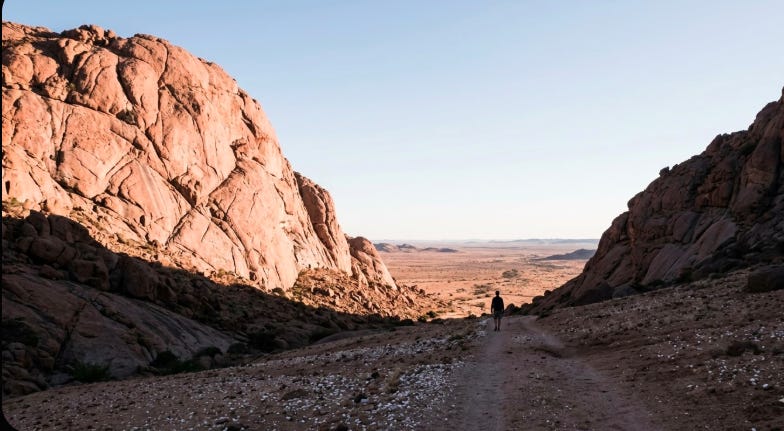
This is the walking road to Springbok. Generations have taken it. My grandfather took it, before the paved route existed. I do not know how many times. I do not know what he carried, or what he found on the other side.
I walk it now, not to arrive anywhere. Just to be in the gap, between the mountains, between the light and the shadow, between what was and what is.
II
Ahead, something breaks the path. A small cairn, knee-high. Five flat stones stacked.
I stop. The wind continues. My breathing is loud in the silence.
I kneel in the dust and look.
The stones were not random. They were chosen. The bottom stone is the largest, sunk slightly into the dirt. It has settled. The second stone is darker than the rest, almost black, with a streak of quartz running through it. The third is pink granite, same as the mountain walls. The fourth is smaller, a compromise, wedged in to keep the stack straight. The fifth is the smallest, a capstone, balanced perfectly.
Five stones, each one necessary. Each one carried here, placed, checked for balance, left.
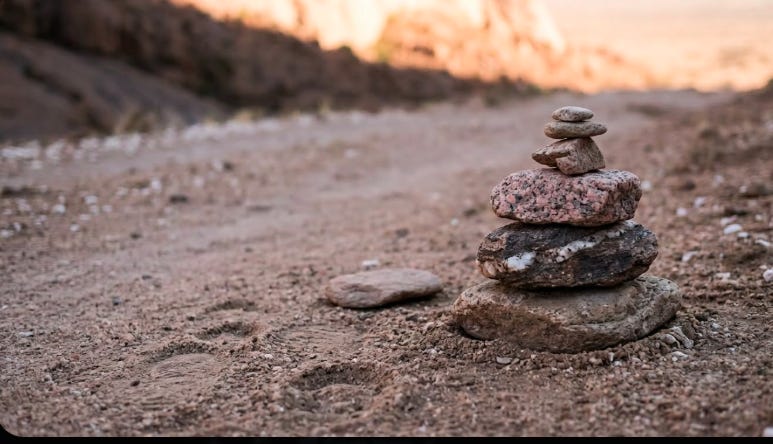
Beside them, a sixth stone lies on the ground.
Slightly behind. To the left. It is the right shape: flat, palm-sized, suitable. But it is not used. It rests on the dirt as if waiting.
III
At the base of the cairn, pressed into the earth, are depressions. They could be footprints. They are smaller than my feet. They lead towards the cairn, stop, and then lead away, back in the direction of Bergsig.
I cannot be certain. I did not write them down when I first came here. Memory is not a notebook. What I remember is the shape of them, the direction, the way they seemed to tell a story: someone walked here, built this, and walked home. They left no note. They did not need to.
But the depressions could also be animal marks, or water runnels, or nothing at all. I do not know. The uncertainty stays in the telling.
IV
The questions come whether I want them or not.
Who built this? Someone from Bergsig, walking to Springbok or coming back. Someone with time, with patience, with something to mark or ask or leave behind.
Was it a prayer? A marker? A game? A memorial?
Why leave the sixth stone? The sun had left the gap by the time I arrived. Had it left when they were here too? Did they run out of light? Run out of skill? Did they mean to come back and finish, and never did?
The sixth stone’s position, slightly behind and to the left, suggests rejection. Or intention. Or simply the place where they set it down while they worked, and then forgot.
I have no answers. The cairn gives nothing away.
V
The sixth stone is flat. Palm-sized. Suitable.
It could have been the capstone. It could have been the base. It could have been wedged into the gap where the fourth stone now sits, the compromise, the one that barely holds.
But it is not used. It lies on the ground, and in its lying it tells more than the stacked stones tell.
The stacked stones say: ‘This is what I made.’ They are completion, intention, a mark left behind. They are the story the builder wanted to tell.
The sixth stone says: ‘This is what I did not use.’ It is the rejection, the hesitation, the moment of change. It is the part of the story the builder did not intend to tell but could not hide.
The cairn concerns the stone left lying more than the stones stacked. The unused thing, the unfinished thing, the thing that waits: that is where the story lives.
VI
A dark streak runs diagonally through the granite wall to my left. Copper. The mountain holding what was taken.
For two hundred years, men from these towns, including Springbok, Okiep, Nababeep and Concordia, went into the earth after that metal. They came out with stained hands and collapsed lungs and stories they did not tell. My grandfather was one of them. He worked the copper. He walked this path.
I wondered, kneeling there, if he had seen this cairn. If he had stopped here, fifty years ago, and added a stone. If he had been the one called away before he could finish, leaving the sixth lying in the dust.
I will never know. That is not false modesty. It is fact. The cairn holds its story, and my grandfather is not here to tell his.
But the wondering itself is a kind of knowing. Not knowing the answer. Knowing the question. Knowing that the question matters.
VII
The Nama built nothing permanent. No stone walls. No monuments. No cathedrals.
They moved with the seasons, following water and grazing, leaving only scatter: quartz chips where a matjieshuis stood, ash from a fire, paths worn by cattle into the living rock. Archaeologists find these traces and call them sites. The people who made them left no names.
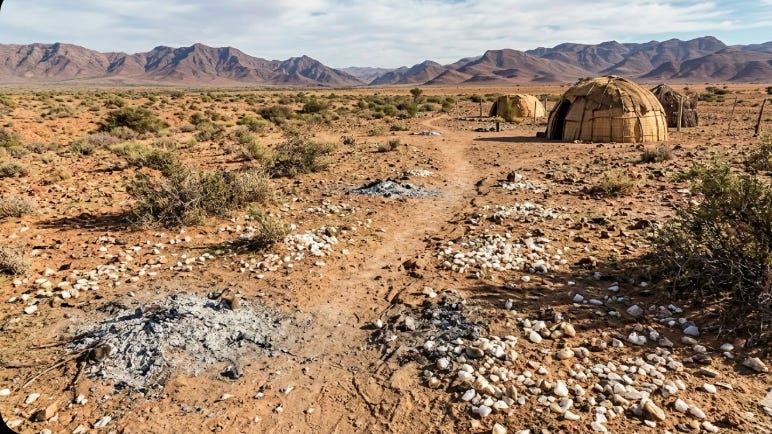
I know this not because I am an expert. I know it because I am from here. Because the scatter is under my feet when I walk. Because the quartz pebbles that flash white in this path are the same quartz my ancestors left behind.
The cairn differs from scatter. It is a deliberate stack. Someone wanted to leave a mark. Someone wanted to say: ‘I was here.’
But the principle is the same. Meaning is not only in what is built. It is in what is left behind. The scatter. The unused stone. The depression that may or may not be a footprint.
VIII
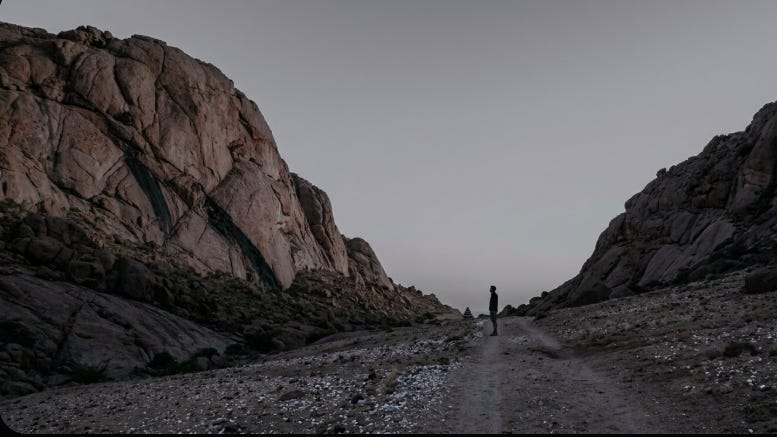
The light has shifted while I knelt. The western wall, which glowed when I arrived, is now shadowed. The eastern wall holds the last sun. The gap between them is grey.
I stand. My knees crack. The sound is loud in the silence.
I look at the cairn one last time. Five stones stacked. One stone waiting.
I do not know who built it. I do not know why. I do not know if it is a prayer, a marker, a game, a memorial. I do not know if it is new or old, if it will stand another year or fall tomorrow.
But I knelt in the dust. I touched the cool stone. And for a moment, I was not reading scatter. I was standing in someone’s choice, still warm from their hands, still waiting
.
IX
I walk back through the gap. The road behind me is darker than the road ahead.
The cairn will stand until someone knocks it down. The sixth stone will wait until someone uses it, or kicks it aside, or leaves it waiting forever.
My people built nothing permanent. They left scatter, and the scatter taught us to read absence.
This cairn differs from scatter. It represents a choice.
I do not know whose.
But I know the choice is still there, in the gap between the mountains, in the space between what was used and what was left.
Still waiting.
Field Note: On Choosing the Sixth Stone
I chose the sixth stone because it was not used. The five stacked stones were obvious. They were the thing I was meant to see. The sixth lay behind them, slightly to the left, palm-sized, suitable. It had been carried there, selected, then left.
For weeks I asked myself why. I wanted an answer. I wanted to close the circle. But the stone would not give me one. It just lay there, waiting, doing nothing.
In literary journalism, we call this a loaded detail. It carries weight because it is incomplete. It asks a question it will not answer. It is the third detail, the one someone who stayed five minutes would miss. The stacked stones tell one story. The sixth stone tells the story behind the story.
I also learned, in drafting this piece, that the sixth stone could serve as a metonymic pivot: a way to move from the micro, one unused stone in one cairn, to the macro, the way my people have always lived between presence and absence. We built nothing permanent. We left scatter. And yet the scatter taught us to read what was not there.
This essay is the result of that noticing. But the noticing did not happen in one moment. It happened in the repetition of the same walk, the same gap, the same cairn, the same stone that would not explain itself. The drills taught me to sit still. The stone taught me to live with not knowing.
For the Reader
Have you ever found something that refused to explain itself? A stone, a mark, a silence that would not close? I would like to hear about it. Tell me in the comments what you noticed when you stopped looking for answers and started looking at what was actually there.
Ben Marvan is a apprentice literary journalist living in Bergsig, Namaqualand. His work documents the people, places, and silences of the Northern Cape province.