

This log documents what I learned about writing from inside a garage in Concordia, where a blind man named Petrus Simboya teaches Nama to anyone who will learn. The assignment asked for an observed scene and a lens paragraph naming my connection, limitation, and accountability. Here is what I wrote, and here is what the process taught me
.
The Assignment
Write a 300-word observed scene from your territory. Add a 50-word lens paragraph naming your connection, limitation, and accountability. Your presence must serve one of three functions: witness, connection, or accountability. You are not the story. The people are the story.
The Raw Material
Observed Scene
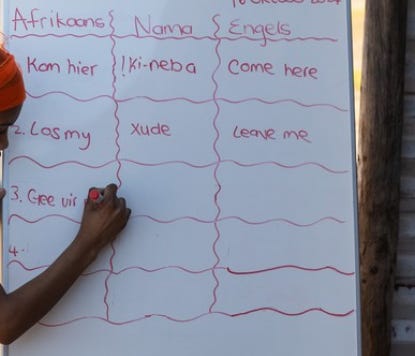
The classroom is a converted garage behind Petrus Simboya’s house in Concordia. Three wooden benches, a whiteboard on wheels, a map of the Northern Cape taped to the corrugated iron wall. Seven learners sit in a half-circle. The oldest is seventy. The youngest is eight.
Petrus stands at the front, his hands resting on a wooden chair. He is blind. He does not need to see them to know they are listening. His voice moves through the room like a person walking a familiar path. He stops. He starts again. He stops again. The room waits.
‘ǁ’ he says. The lateral click. Broad, wet, sliding. The sound of a goat’s hoof lifting from damp earth.
The learners repeat it. Some get it right. Some get it close. He does not correct them immediately. He lets the sound settle. Then he says it again. ‘ǁ’. His tongue fixes against the roof of his mouth. The sides pull inward. Air rushes along his molars. The sound is older than this town, older than the church, older than the mine. It is the sound of the land before it had a name in any other language.
A girl of twelve tries again. This time it comes out clean. Petrus nods. ‘ǁgarib,’ he says. Great River. The Orange River before the English named it. ‘ǁgarib,’ she repeats. She is learning to speak a language her great-grandparents were punished for speaking. The garage holds them all: the blind teacher, the young girl, the elders in the back row, the clicks that will not be silenced.
Lens Paragraph
My grandmother walked these streets before the school existed. She would not speak Nama. She said it was a language for the veld, not for the house. I did not understand that until now. I am here because Petrus allows it. What I have written is only what I saw and heard. I will show him this before I share it. The story is his. I am just the one who was there.
The Struggle
The hardest part was keeping myself out of the garage. My instinct was to write about what the clicks meant to me, to name the grief of a language suppressed and the hope of its return. I wanted to explain that my grandmother refused to speak Nama, that her silence was a wound passed down, that watching the girl learn the lateral click felt like watching something being restored.
I had to stop. Those feelings are real, but they are not observable. The reader cannot see my grief. They can see a blind man teaching. They can see a girl repeating a sound. They can hear the click. That is enough. The meaning will follow, or it will not. Either way, it is not mine to impose.
The lens paragraph was a different kind of struggle. I had to name my connection without making it the centre. ‘My grandmother walked these streets.’ That is a fact. It places me in relation to the place without claiming authority. ‘I am here because Petrus allows it.’ That is accountability. It reminds the reader that access is permission, not a right.
The limitation was harder. I wanted to say ‘I do not speak Nama.’ That is true, but it felt like an apology. I chose instead: ‘What I have written is only what I saw and heard.’ That is not an apology; it is a boundary.
The Breakthrough
I learned that the lens paragraph is not a confession. It is a contract.
When I wrote ‘My grandmother walked these streets before the school existed,’ I was not asking for sympathy. I was establishing that I am not a stranger. I have a right to be here, but that right is inherited, not earned. The sentence does the work of connection without demanding that the reader feel anything about it.
When I wrote ‘I will show him this before I share it,’ I was not performing virtue. I was stating a procedure. The reader now knows that what they are reading has been checked by the person who lived it. That is accountability. It is not a promise to be good. It is a description of how the work was made.
The breakthrough was realising that the lens paragraph is not about me. It is about the reader’s trust. Every sentence in the lens should answer a question the reader might have: Why are you here? What gives you the right? Can I believe you? If the lens does not answer those questions, it is just autobiography, and autobiography is not the assignment.
One Tool to Keep
Name your connection as a fact, not a feeling.
‘My grandmother walked these streets’ is a fact. ‘I feel connected to this place because of my grandmother’ is a feeling. The fact carries weight. The feeling carries only the author. When you name the connection as something that happened, something you did, something someone else said, you give the reader a hook to hang their trust on. Feelings are invisible. Facts are not.
The Progress
Before this exercise, I would have written the scene and stopped. The lens would have felt like an add-on, a confession, a moment of writerly vulnerability. Now I see it differently. The lens is not decoration. It is the ethical frame that holds the scene in place. Without it, the reader does not know why I was in that garage or whether I have the right to write about what I saw.
The lens also protects me. It names my limitation before someone else does. ‘What I have written is only what I saw and heard.’ That is a boundary, not a weakness. It says: I am not claiming to know everything. I am claiming to have been there, to have paid attention, and to have written down what I witnessed.
The next time I write a scene from Bergsig or Concordia or the gap between the mountains, I will write the lens first, not because it is more important but because it is the foundation. The scene rests on it. If the lens is honest, the reader will follow. If the lens is performative, they will feel it and stop reading.
The classroom at Aitsama taught me this. Not the clicks. Not the girl. The act of standing in a garage with a notebook, watching a blind man teach a language his students were once punished for speaking, and knowing that I have to earn the right to write any of it down. That is the lens. That is the work.
This is deeply moving work, and I am most moved in my heart and soul for the blind man who can still provide these lessons to young and old, and for allowing you the space to be there and share them through this transformative lens, despite so many difficulties and obstacles arising from the past.