
A Change in Approach

A shift in approach: from learning to see anywhere to learning to see here. This is what it means to turn the observation drills toward home—toward Namaqualand, its people, its silence, and the responsibility of belonging.
When I started this Substack, I thought literary journalism was about mastering techniques. Observation drills. Loaded details. The ‘So What?’ test. I practised in libraries and taxi ranks, in generic spaces where anyone could sit. The exercises were necessary. They calibrated the eye.
But a calibration is not a direction.
The direction was always here. I just needed to see it.
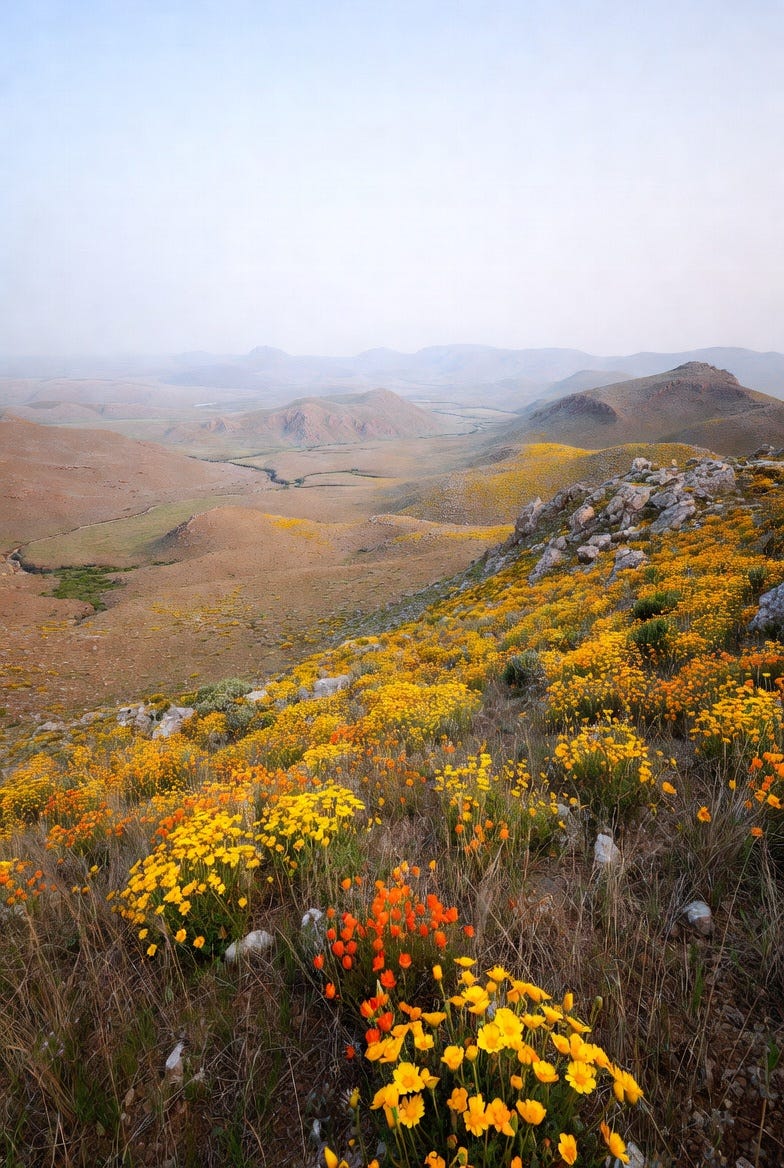
I live in Bergsig, on the slopes above Springbok. This is Namaqualand. The granite klippe that hold the day’s heat and release it at night. The winter rain that decides whether the flowers come. The gravel roads that lead to houses where people sit on the stoep and watch the light change.
Silence between houses is not empty. It carries two thousand years of movement: Khoekhoen pastoralists, San hunters, trekboers, Basters, miners—the ones who stayed and the ones who left. The wind has names here. The plants have names in three languages, two of them fading.
I have been learning to hear what the silence holds.
The shift is simple. I will no longer write about anywhere. I will write about here.
Not because here is all that matters. Because here is where I belong. And belonging is not the same as knowing. Being from this place does not make me an expert. It makes me responsible. Responsible to see clearly. To listen humbly. To ask permission. To know when not to write.
The reader will know I belong here not because I say so but because of what I notice: the way a bakkie is parked, the rhythm of Namaqualand’s Afrikaans, the references that need no explanation. Those details will do the work that labels cannot.
The Gallery will hold finished pieces rooted in Namaqualand. Portraits of people I have sat with. Local mysteries. Observed rituals. The small things that contain the whole.
The Workshop Log will continue, but the raw material will change. I will document what it means to observe where you belong. The ethical questions that arise when the people you write about are your neighbours. The language challenges—the words I cannot translate, the syntax I am watching disappear.
What stays the same is the learning in public. The failed drafts. The craft struggles. The commitment to fact told as story. The voice: reflective, precise, grounded in what I can verify.
I am not apologising for the earlier work. Those drills taught me how to see. Now I know what to look at.
The gravel road outside my window needs grading again. Someone will decide when. I do not know who. I do not know why. But I notice. And noticing is where it starts.
B,M.